


Description
A waveguide twist is a passive component used to rotate the polarization of an electromagnetic wave as it travels through a waveguide. It’s especially useful when aligning waveguide ports with mismatched orientations or when integrating components with different polarization axes. Key Features: - Function: Rotates the E-field (electric field) or H-field (magnetic field) by a specific angle—commonly 45°, 60°, or 90°. - Types: - E-plane twist: Rotates the electric field. - H-plane twist: Rotates the magnetic field. - Combination twist: Rotates both, often used in compact or complex layouts. - Construction: Can be smooth (continuous) or stepped. Stepped twists (e.g., 3-, 5-, or 7-step) offer better VSWR and broader bandwidth. - Performance: Typical VSWR < 1.05:1, insertion loss < 0.2 dB, depending on design and frequency band. Frequency Range: Available for waveguide sizes from WR-10 (75–110 GHz) up to WR-2300 (320 MHz), depending on the application.
other Products
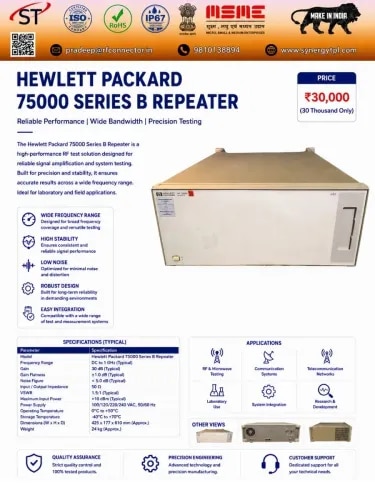 HEWLETT PACKARD Hewlett-Packard (HP) 75000 Series B is a modular VXIbus instrumentation platform designed for automated electr
HEWLETT PACKARD 75000 S...
INR 30000- AGILENT Agilent E4408B ESA-L Spectrum Analyzer is a professional RF and microwave spectrum analyzer covering a frequen
AGILENT E4408B SPECTRUM...
INR 750000  ANRITSU Anritsu ML2438A Power Meter is a high-performance dual-channel RF and microwave power measurement instrument d
ANRITSU ML 2438A POWER ...
INR 100000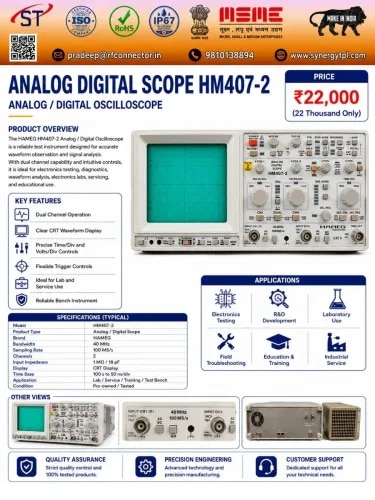 HAMEG HAMEG HM407-2 is a 40 MHz, two-channel analog/digital storage oscilloscope designed for laboratory, service, e
HAMEG HM407 -2 ANALOG /...
INR 22000 ALTUSEN ALTUSEN PN9108 Power Over the NET™ is an 8-port network-controlled AC power management device designed to prov
ALTUSEN PNS108 POWER OV...
INR 100000