

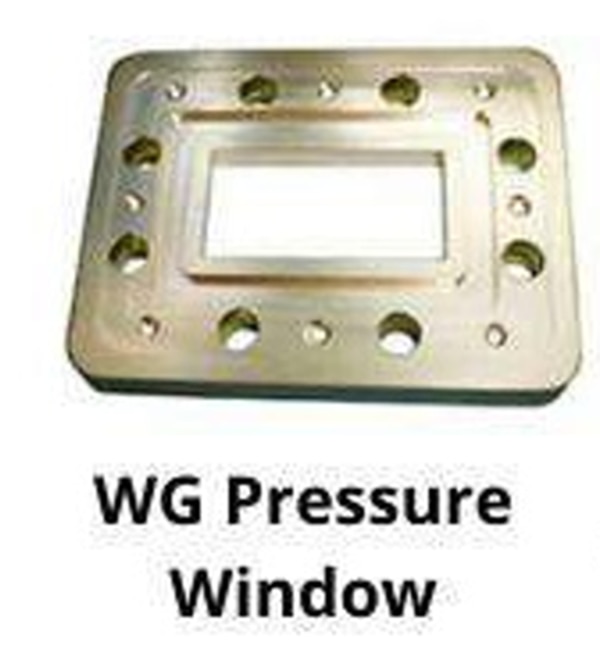
Description
A waveguide (WG) pressure window is a specialized RF component that allows electromagnetic signals to pass through a waveguide while maintaining a hermetic seal between pressurized and non-pressurized sections. It’s essential in systems where environmental isolation, vacuum integrity, or gas pressurization is required—such as in satellite payloads, radar systems, and high-power microwave setups. 🔍 Key Technical Features: - Function: Maintains pressure differential while allowing RF energy to pass with minimal loss. - Frequency Range: Typically from 0.32 GHz to 112 GHz, depending on waveguide size (e.g., WR-2300 to WR-10). - VSWR: As low as 1.2:1, ensuring good impedance matching. - Insertion Loss: Typically ≤ 0.2 dB across the passband. - Pressure Rating: Up to 70 psi, suitable for vacuum or pressurized systems. - Materials: - Window: Teflon-fiberglass, Kapton, or ceramic (e.g., alumina) for low-loss transmission. - Body: Aluminum, brass, or copper alloy with chromate or Surtec finish for corrosion resistance. 🛠️ Construction Types: - Flat dielectric windows (e.g., mica, Kapton) for standard applications. - Soldered glass windows for hermetic sealing in high-reliability systems. - Double-ridged variants for broadband and high-power use in dusty or humid environments. 🛰️ Applications: - Satellite communications: Isolates pressurized payloads from external waveguide runs. - Radar systems: Protects sensitive electronics from environmental exposure. - Test chambers: Maintains vacuum integrity while allowing signal injection.
Keywords
other Products
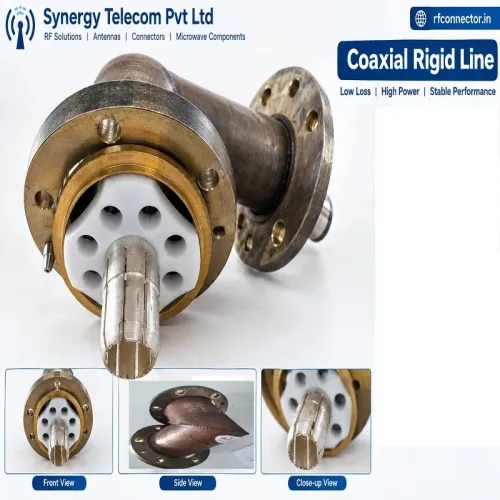 RF CONNECTOR HOUSE Parameter Specification Product Coaxial Rigid Line Type Rigid Coaxial Transmission Line Impedance 50 Ω Constru
COAXIAL RIGIT LINE
INR 50000INR 80000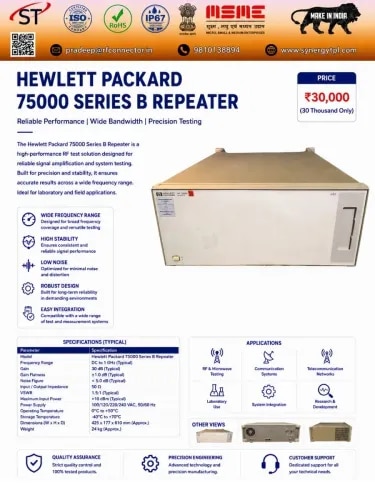 HEWLETT PACKARD Hewlett-Packard (HP) 75000 Series B is a modular VXIbus instrumentation platform designed for automated electr
HEWLETT PACKARD 75000 S...
INR 30000- AGILENT Agilent E4408B ESA-L Spectrum Analyzer is a professional RF and microwave spectrum analyzer covering a frequen
AGILENT E4408B SPECTRUM...
INR 750000 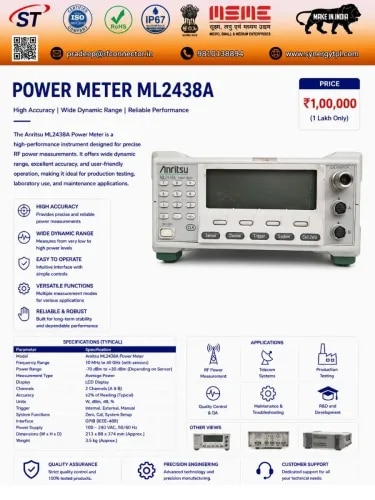 ANRITSU Anritsu ML2438A Power Meter is a high-performance dual-channel RF and microwave power measurement instrument d
ANRITSU ML 2438A POWER ...
INR 100000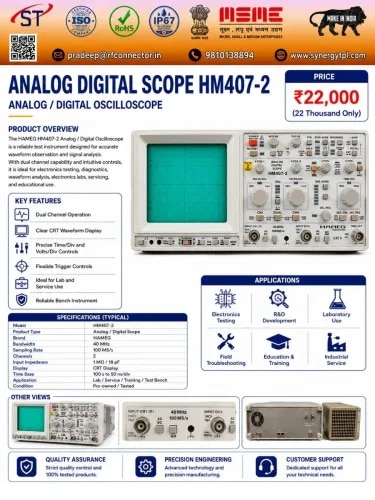 HAMEG HAMEG HM407-2 is a 40 MHz, two-channel analog/digital storage oscilloscope designed for laboratory, service, e
HAMEG HM407 -2 ANALOG /...
INR 22000