

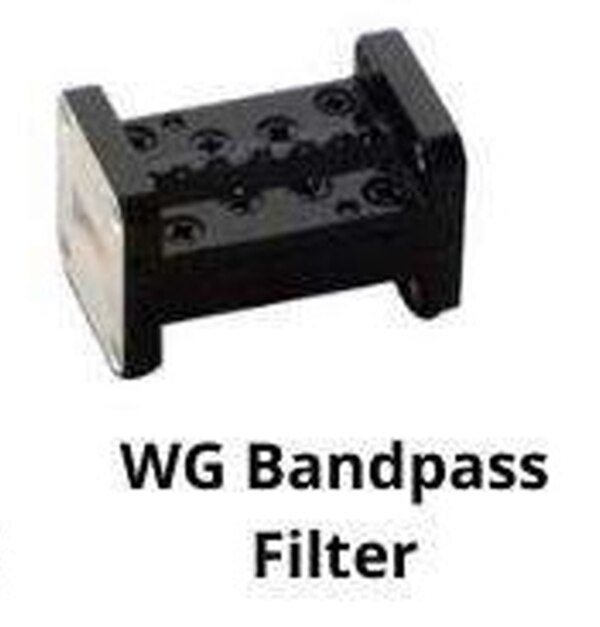
Description
A waveguide (WG) bandpass filter is a precision RF component that allows signals within a specific frequency band to pass while rejecting those outside it. These filters are prized for their low insertion loss, high power handling, and excellent selectivity, especially in microwave and millimeter-wave systems. Core Design Features: - Structure: Typically consists of a series of resonant cavities or inductive irises inside a hollow waveguide. These cavities are spaced at λ/4 intervals to create the desired passband response. - Frequency Range: Depends on the waveguide size—e.g., WR90 for X-band (8.2–12.4 GHz), WR28 for Ka-band (26.5–40 GHz). - Bandwidth: Usually 1–10% of the center frequency, though wider bandwidths are achievable with advanced coupling techniques. - VSWR: Often ≤ 1.2:1, ensuring minimal reflection. - Rejection: Out-of-band attenuation can exceed 40 dB, critical for adjacent channel suppression. Applications: Used in radar, satellite transponders, electronic warfare systems, and high-frequency test setups. For example, in satellite systems like APSTAR-6, a WG bandpass filter ensures clean channel separation and prevents spurious emissions.
other Products
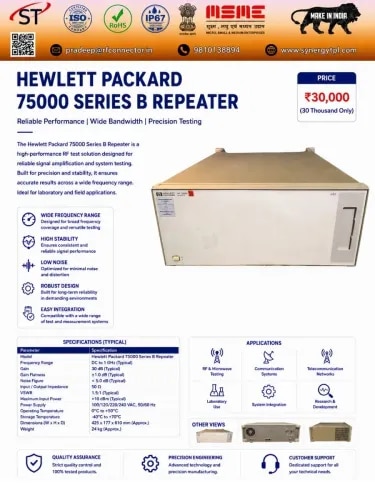 HEWLETT PACKARD Hewlett-Packard (HP) 75000 Series B is a modular VXIbus instrumentation platform designed for automated electr
HEWLETT PACKARD 75000 S...
INR 30000- AGILENT Agilent E4408B ESA-L Spectrum Analyzer is a professional RF and microwave spectrum analyzer covering a frequen
AGILENT E4408B SPECTRUM...
INR 750000 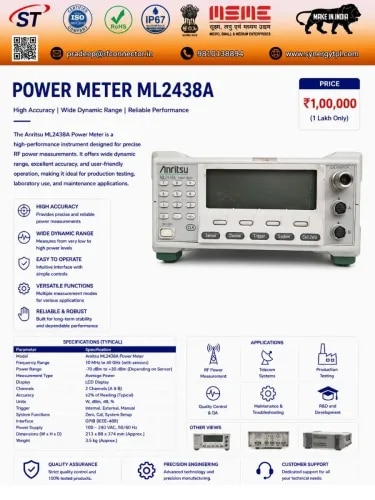 ANRITSU Anritsu ML2438A Power Meter is a high-performance dual-channel RF and microwave power measurement instrument d
ANRITSU ML 2438A POWER ...
INR 100000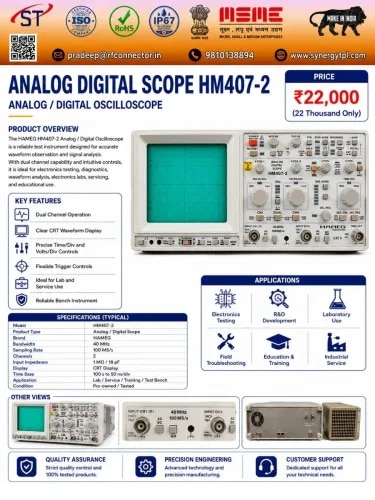 HAMEG HAMEG HM407-2 is a 40 MHz, two-channel analog/digital storage oscilloscope designed for laboratory, service, e
HAMEG HM407 -2 ANALOG /...
INR 22000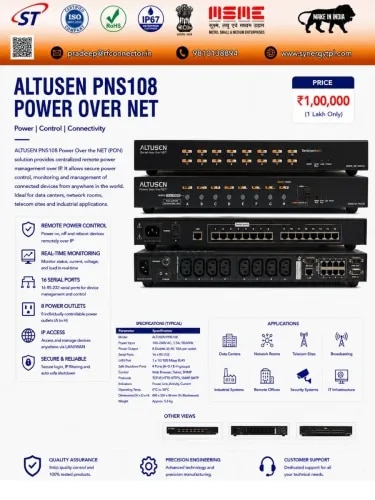 ALTUSEN ALTUSEN PN9108 Power Over the NET™ is an 8-port network-controlled AC power management device designed to prov
ALTUSEN PNS108 POWER OV...
INR 100000