


Description
The term "UHF M LMR 400 CRIMP" refers to a specific type of coaxial cable connector and associated process used in radio frequency (RF) applications, particularly for antenna and communication systems. Here’s a breakdown of each part of this term: 1. UHF (Ultra High Frequency) UHF refers to a range of radio frequencies typically between 300 MHz and 3 GHz. UHF is used for various communication purposes, including television broadcasting, mobile phones, and radio communications. In the context of "UHF M," it likely indicates a UHF connector designed for male (M) applications, which connects to other devices, such as antennas or transceivers. 2. M (Male) In connector terminology, "M" stands for "male." Male connectors have pins that are inserted into a corresponding female connector, which has sockets. In RF communications, male connectors are used on cables or devices to establish connections with female counterparts. 3. LMR 400 LMR 400 is a type of coaxial cable widely used in RF and communications systems. It is known for its low attenuation (signal loss) and high performance over a wide frequency range. LMR 400 is often used for long cable runs, as it minimizes signal loss and provides reliable transmission. The cable has a 0.4-inch (10.3 mm) outer diameter and is typically used for applications like Wi-Fi, satellite communications, and RF signals in general. 4. CRIMP Crimping refers to the process of attaching a connector to a cable by deforming the connector around the cable’s conductor. In the context of UHF connectors for LMR 400 cable, crimping is the method used to create a secure, low-resistance connection between the UHF connector (such as a male UHF connector) and the coaxial cable. Crimping is preferred for its strong, reliable, and durable connections compared to other methods like soldering. Putting it All Together "UHF M LMR 400 CRIMP" refers to a male UHF connector that is designed for use with LMR 400 coaxial cable and is attached to the cable using a crimping technique. This type of setup is common in high-frequency applications where signal integrity and durability are essential, such as in radio communications, wireless networking, and other RF-related uses. The crimping process ensures a stable and secure connection that minimizes signal loss and maintains reliable performance over time. Common Uses Communication Systems: UHF M LMR 400 crimp connectors are often used in two-way radios, satellite communications, and Wi-Fi systems. Antennas: These connectors are commonly used to link antennas with RF equipment. Test Equipment: UHF connectors are frequently used in laboratory testing and diagnostics of RF systems. By combining the UHF male connector with the high-performance LMR 400 cable and a crimping technique, this setup ensures reliable, low-loss transmission, even over longer cable lengths.
Keywords
other Products
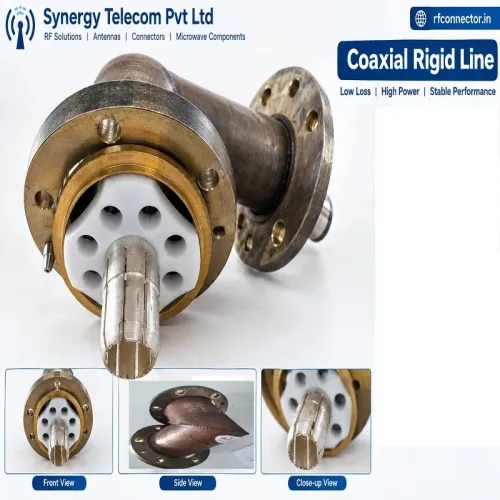 RF CONNECTOR HOUSE Parameter Specification Product Coaxial Rigid Line Type Rigid Coaxial Transmission Line Impedance 50 Ω Constru
COAXIAL RIGIT LINE
INR 50000INR 80000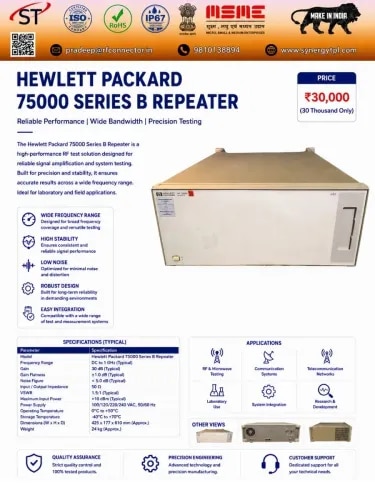 HEWLETT PACKARD Hewlett-Packard (HP) 75000 Series B is a modular VXIbus instrumentation platform designed for automated electr
HEWLETT PACKARD 75000 S...
INR 30000- AGILENT Agilent E4408B ESA-L Spectrum Analyzer is a professional RF and microwave spectrum analyzer covering a frequen
AGILENT E4408B SPECTRUM...
INR 750000 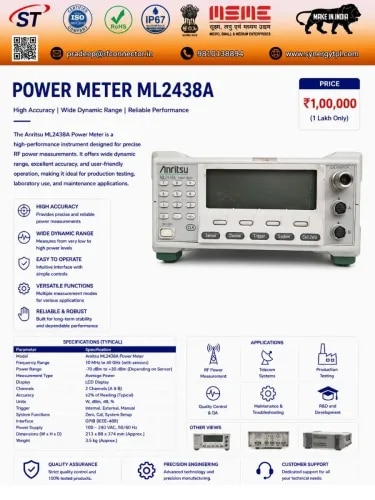 ANRITSU Anritsu ML2438A Power Meter is a high-performance dual-channel RF and microwave power measurement instrument d
ANRITSU ML 2438A POWER ...
INR 100000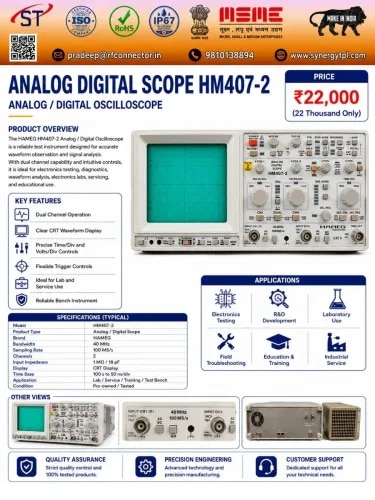 HAMEG HAMEG HM407-2 is a 40 MHz, two-channel analog/digital storage oscilloscope designed for laboratory, service, e
HAMEG HM407 -2 ANALOG /...
INR 22000