


Description
The term "DIN M4 hole solder" appears to be a combination of several concepts, including "DIN," "M4," and "hole solder." Let’s break this down to understand each part: DIN (Deutsches Institut für Normung): DIN stands for the German Institute for Standardization (Deutsches Institut für Normung). It is a recognized organization that develops standards for various industries, including electrical and mechanical engineering. DIN standards cover a wide range of technical specifications and norms that help ensure quality, safety, and interoperability across different products and processes. In this context, "DIN" typically refers to a standardized size or specification. M4: M4 refers to a metric thread size used for screws, bolts, or other fasteners. The "M" stands for metric, and the number "4" indicates the nominal diameter of the fastener in millimeters, which is 4 mm. M4 screws or bolts are commonly used in electronic and mechanical applications, where compact and lightweight fasteners are required. Hole Solder: Hole solder likely refers to soldering done through a hole on a printed circuit board (PCB) or another surface, often for the purpose of attaching components such as wires, leads, or pins. In PCB manufacturing, holes are drilled to allow components to pass through, and soldering is used to create a reliable electrical connection. This is especially common in through-hole technology (THT), where components have leads that go through the board and are soldered on the other side. The phrase "hole solder" could also refer to a soldering process applied specifically to these through-holes, ensuring the component is securely fixed and electrically connected.
Keywords
other Products
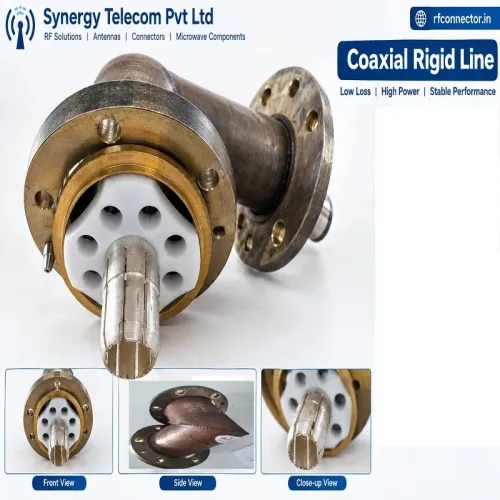 RF CONNECTOR HOUSE Parameter Specification Product Coaxial Rigid Line Type Rigid Coaxial Transmission Line Impedance 50 Ω Constru
COAXIAL RIGIT LINE
INR 50000INR 80000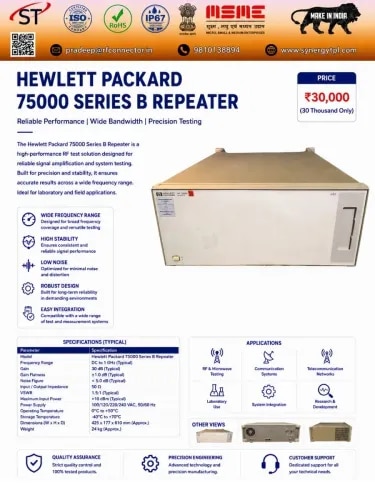 HEWLETT PACKARD Hewlett-Packard (HP) 75000 Series B is a modular VXIbus instrumentation platform designed for automated electr
HEWLETT PACKARD 75000 S...
INR 30000- AGILENT Agilent E4408B ESA-L Spectrum Analyzer is a professional RF and microwave spectrum analyzer covering a frequen
AGILENT E4408B SPECTRUM...
INR 750000 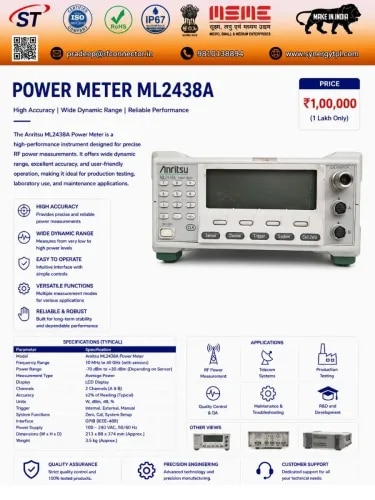 ANRITSU Anritsu ML2438A Power Meter is a high-performance dual-channel RF and microwave power measurement instrument d
ANRITSU ML 2438A POWER ...
INR 100000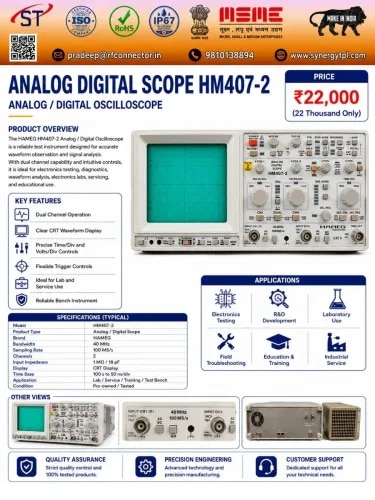 HAMEG HAMEG HM407-2 is a 40 MHz, two-channel analog/digital storage oscilloscope designed for laboratory, service, e
HAMEG HM407 -2 ANALOG /...
INR 22000