


Description
DIN F LMR 400 Crimp refers to a type of connector used in coaxial cable systems, specifically designed for LMR 400 cables. Let's break down the components of this definition: DIN F: DIN refers to the Deutsche Industrie Norm, a set of standards established by the German Institute for Standardization (DIN). In the context of connectors, "DIN F" likely refers to a particular type of connector that is compliant with DIN standards, often used in industrial or RF (Radio Frequency) applications. The "F" likely indicates a specific type of connector in this system. It could be related to a female connector type, as "F" often denotes the female end of a connector. LMR 400: LMR 400 is a type of coaxial cable, a widely used cable for RF and communication systems. It's often chosen for its relatively low loss over long distances, making it ideal for wireless communications, antenna systems, and high-performance networking. The "400" refers to the cable's diameter, which is about 0.405 inches (10.3 mm). LMR 400 cables are often used in applications such as cellular networks, antenna installations, and other RF communication needs. Crimp: Crimping is a method of connecting the connector to the cable. In this process, the cable's shield and center conductor are physically pressed or "crimped" into the connector to establish a secure electrical and mechanical connection. Crimping is a popular choice because it is reliable, easy to perform, and doesn't require soldering. Crimp connectors for LMR 400 are typically used in situations where a robust connection is required and can be done with crimping tools. Applications: Telecommunications: LMR 400 cables are often used for RF transmission lines, where low signal loss and high durability are important. The DIN F LMR 400 crimp connectors are used to attach connectors to the ends of these cables for a secure and efficient connection. Antenna Systems: In antenna installations, connectors like DIN F LMR 400 crimp types are frequently used to connect cables to antenna ports or transmitters and receivers. Networking: They may be used in networking equipment where high-frequency signals are transmitted over coaxial cables. Advantages: Low Signal Loss: LMR 400 is known for its low attenuation and high performance in RF applications, making it ideal for long-distance signal transmission. Durability: The crimping method provides a stable, durable connection, preventing issues such as signal degradation or connection failure. Versatility: The DIN F LMR 400 crimp connectors are suitable for a variety of applications, from industrial use to consumer electronics and telecommunications. In summary, a DIN F LMR 400 Crimp refers to a type of coaxial connector that uses the crimping method to securely attach to an LMR 400 cable, providing a reliable connection for RF applications in telecommunications and networking.
Keywords
other Products
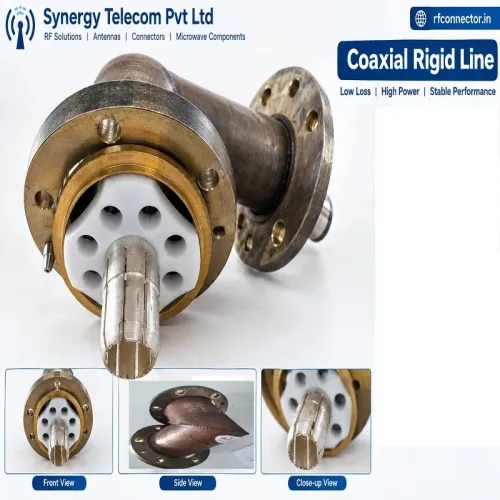 RF CONNECTOR HOUSE Parameter Specification Product Coaxial Rigid Line Type Rigid Coaxial Transmission Line Impedance 50 Ω Constru
COAXIAL RIGIT LINE
INR 50000INR 80000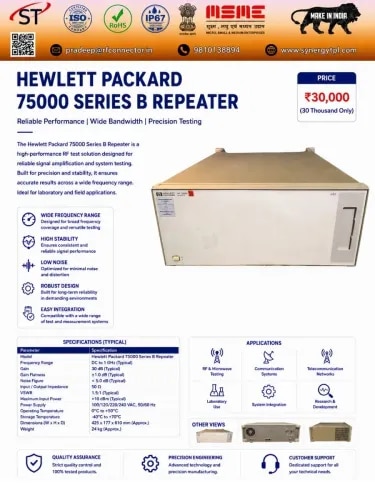 HEWLETT PACKARD Hewlett-Packard (HP) 75000 Series B is a modular VXIbus instrumentation platform designed for automated electr
HEWLETT PACKARD 75000 S...
INR 30000- AGILENT Agilent E4408B ESA-L Spectrum Analyzer is a professional RF and microwave spectrum analyzer covering a frequen
AGILENT E4408B SPECTRUM...
INR 750000 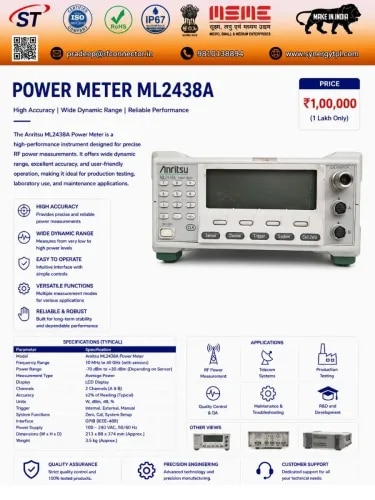 ANRITSU Anritsu ML2438A Power Meter is a high-performance dual-channel RF and microwave power measurement instrument d
ANRITSU ML 2438A POWER ...
INR 100000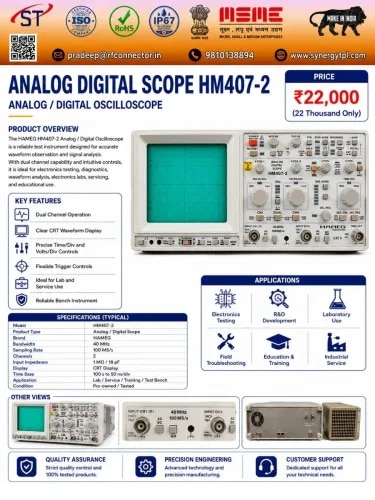 HAMEG HAMEG HM407-2 is a 40 MHz, two-channel analog/digital storage oscilloscope designed for laboratory, service, e
HAMEG HM407 -2 ANALOG /...
INR 22000