


Description
The term DIN F BH RA LMR 200 CRIMP likely refers to a specific type of connector, cable, or crimping tool specification related to coaxial cables, typically used in telecommunications and networking. Here's a breakdown of each part: DIN: This typically refers to "Deutsches Institut für Normung," the German Institute for Standardization. In this context, it could refer to a connector standard or a component that adheres to DIN specifications, ensuring compatibility with European standards. F: This generally refers to an F-type connector, which is commonly used for coaxial cables. F connectors are frequently used in applications like cable TV and satellite systems. BH: This could be a part of a specific cable or connector type, but without more context, it's unclear. It might refer to a variant of the connector or a particular feature of the assembly (e.g., the length or type of termination). RA: This typically stands for Right-Angle, referring to the design of the connector. A right-angle connector has a 90-degree bend, making it more suitable for installations with space constraints or where the cable must be routed in a specific direction. LMR 200: This is a type of coaxial cable. LMR (Low Loss Microwave Radio) 200 is a commonly used coaxial cable that has lower loss characteristics, making it ideal for high-frequency applications. The "200" part typically refers to the cable's diameter (around 0.2 inches or 5.08 mm). CRIMP: This refers to the method used to attach the connector to the cable. Crimping is a process in which a metal connector is securely fastened to the cable by deforming the connector using a crimping tool, creating a strong electrical and mechanical connection. Putting it all together: The term DIN F BH RA LMR 200 CRIMP likely describes a DIN F-type right-angle connector designed for use with LMR 200 coaxial cable that is crimped onto the cable for secure attachment. This type of connector is commonly used in telecommunications, networking, and RF (radio frequency) applications, where low-loss coaxial cable is required for high-frequency signal transmission. The use of a right-angle design helps with managing space and routing the cable in tight or specific installations.
Keywords
other Products
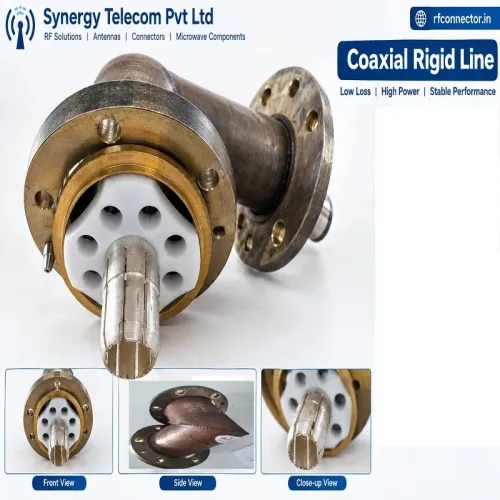 RF CONNECTOR HOUSE Parameter Specification Product Coaxial Rigid Line Type Rigid Coaxial Transmission Line Impedance 50 Ω Constru
COAXIAL RIGIT LINE
INR 50000INR 80000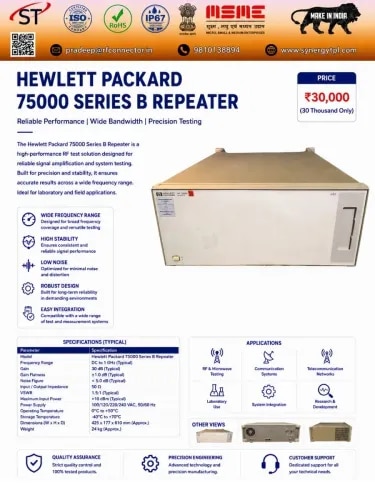 HEWLETT PACKARD Hewlett-Packard (HP) 75000 Series B is a modular VXIbus instrumentation platform designed for automated electr
HEWLETT PACKARD 75000 S...
INR 30000- AGILENT Agilent E4408B ESA-L Spectrum Analyzer is a professional RF and microwave spectrum analyzer covering a frequen
AGILENT E4408B SPECTRUM...
INR 750000 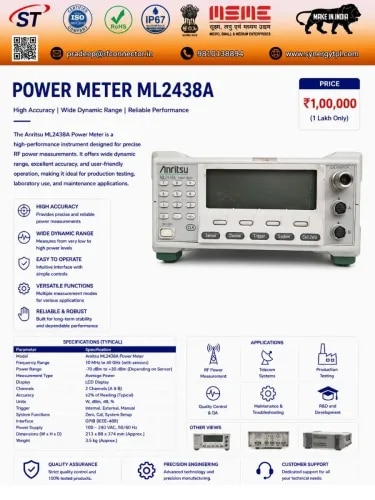 ANRITSU Anritsu ML2438A Power Meter is a high-performance dual-channel RF and microwave power measurement instrument d
ANRITSU ML 2438A POWER ...
INR 100000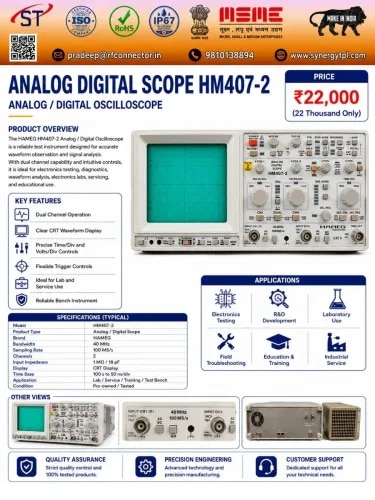 HAMEG HAMEG HM407-2 is a 40 MHz, two-channel analog/digital storage oscilloscope designed for laboratory, service, e
HAMEG HM407 -2 ANALOG /...
INR 22000