

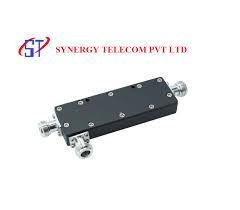
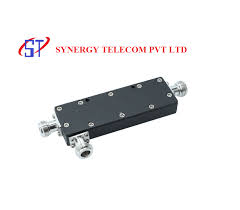
Description
Frequency band coverage: Does it cover the exact band(s) you need (e.g., 698-960, 1710-2700, 3400-3800 MHz)? Coupling tolerance / flatness: How much variation across the band (±dB)? Insertion/thru loss: The smaller the extra loss the better, especially if long coax runs. Directivity & isolation: Higher directivity means better separation of forward vs reflected signals; important if you use the coupler for monitoring/reflection measurement. Power handling: Both average and peak (if applicable). If it's for high-power DAS/IBS, ensure sufficient rating. Connectors & compatibility: Make sure connector types (N, 4.3-10, DIN, SMA) match your system, and that you have adapters if needed. Return loss / VSWR: Good matching means less reflection and better system performance. Impedance: Usually 50 Ω for telecom; ensure that’s the standard.
Other Specifications
| Power Handling: : | 300 W |
| Insertion Loss: : | 1.40 dB |
| Coupling: : | 6 dB |
| VSWR: : | 1.25 |
| Impedance : | 50 Ω |
other Products
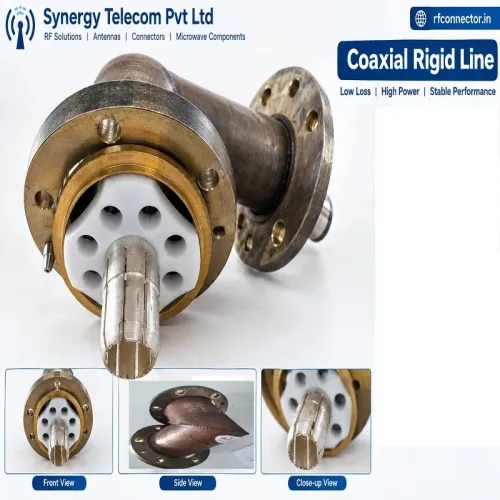 RF CONNECTOR HOUSE Parameter Specification Product Coaxial Rigid Line Type Rigid Coaxial Transmission Line Impedance 50 Ω Constru
COAXIAL RIGIT LINE
INR 50000INR 80000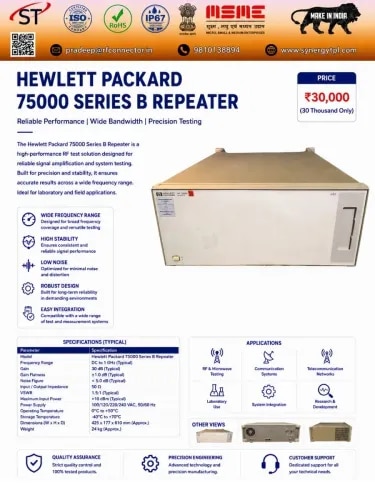 HEWLETT PACKARD Hewlett-Packard (HP) 75000 Series B is a modular VXIbus instrumentation platform designed for automated electr
HEWLETT PACKARD 75000 S...
INR 30000- AGILENT Agilent E4408B ESA-L Spectrum Analyzer is a professional RF and microwave spectrum analyzer covering a frequen
AGILENT E4408B SPECTRUM...
INR 750000 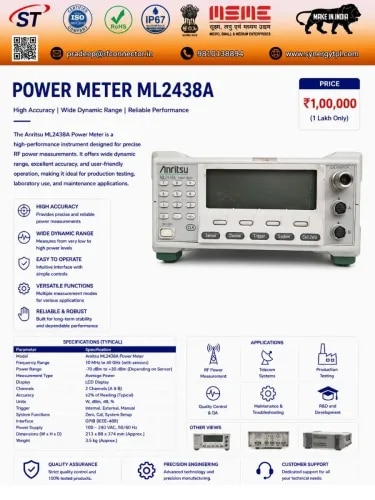 ANRITSU Anritsu ML2438A Power Meter is a high-performance dual-channel RF and microwave power measurement instrument d
ANRITSU ML 2438A POWER ...
INR 100000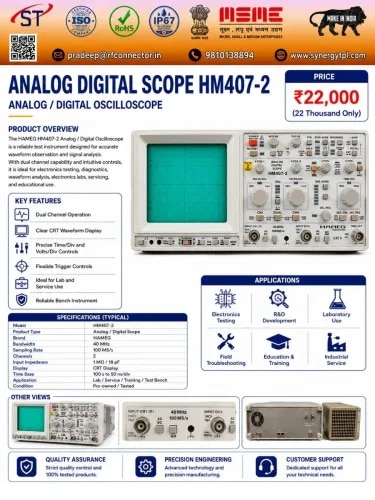 HAMEG HAMEG HM407-2 is a 40 MHz, two-channel analog/digital storage oscilloscope designed for laboratory, service, e
HAMEG HM407 -2 ANALOG /...
INR 22000