

Description
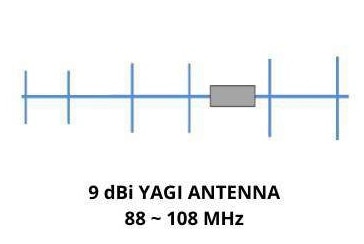
Yagi antennas are directional, high-gain antennas widely used for UHF (300 MHz–3 GHz) and VHF (30–300 MHz) applications, including TV broadcasting, amateur radio (HAM), emergency communications, and military use. Below is a detailed breakdown of their design, types, and best-use cases. 1. Key Features of UHF/VHF Yagi Antennas ✔ Frequency Range: VHF: 30–300 MHz (e.g., FM radio, HAM 2m band [144–148 MHz]). UHF: 300 MHz–3 GHz (e.g., TV broadcasting, HAM 70cm band [420–450 MHz], public safety radios). ✔ Directional Gain: 6–20 dBi (depends on element count). ✔ Polarization: Typically horizontal (for TV/HAM) or vertical (for mobile/emergency comms). ✔ Durability: Aluminum/glass fiber construction for weather resistance. 2. Types of UHF/VHF Yagi Antennas A) Standard VHF Yagi (e.g., 2m HAM Band) Elements: 3–12 (longer boom = higher gain). Example: Diamond X50A (144–148 MHz, 7.2 dBi). Use Case: Amateur radio, emergency communications. B) UHF TV Antenna (470–862 MHz) Elements: 10–20 (high gain for weak signals). Example: Antennas Direct 91XG (UHF, 12.8 dBi). Use Case: Over-the-air (OTA) digital TV reception. C) Dual-Band VHF/UHF Yagi (e.g., 2m/70cm HAM) Example: Comet CA-2X4SR (144/430 MHz, 6.5 dBi). Use Case: HAM radio repeaters, satellite tracking. D) Military/Govt Yagi (25–512 MHz) Example: TACO EL-5204 (30–88 MHz, ruggedized). Use Case: Tactical field communications. E) Compact Portable Yagi (Emergency Use) Example: Arrow II 146/437-10 (Foldable, lightweight). Use Case: Disaster relief, SOTA (Summits on the Air).
other Products
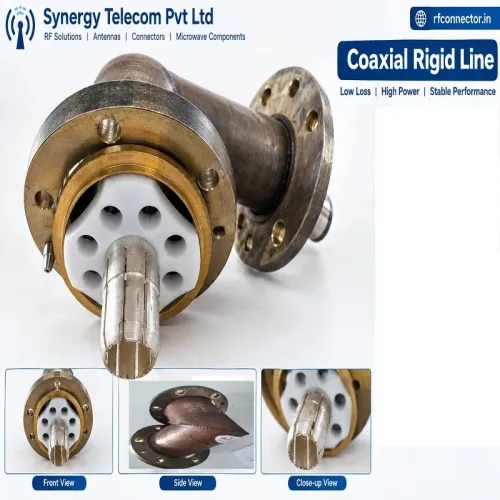 RF CONNECTOR HOUSE Parameter Specification Product Coaxial Rigid Line Type Rigid Coaxial Transmission Line Impedance 50 Ω Constru
COAXIAL RIGIT LINE
INR 50000INR 80000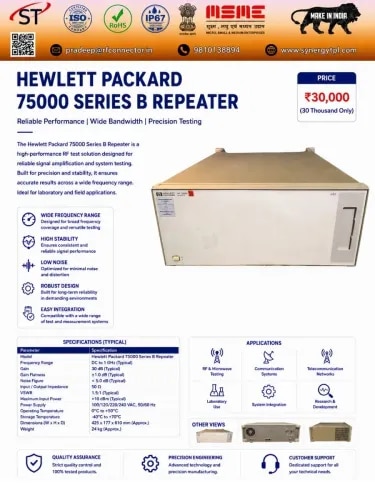 HEWLETT PACKARD Hewlett-Packard (HP) 75000 Series B is a modular VXIbus instrumentation platform designed for automated electr
HEWLETT PACKARD 75000 S...
INR 30000- AGILENT Agilent E4408B ESA-L Spectrum Analyzer is a professional RF and microwave spectrum analyzer covering a frequen
AGILENT E4408B SPECTRUM...
INR 750000 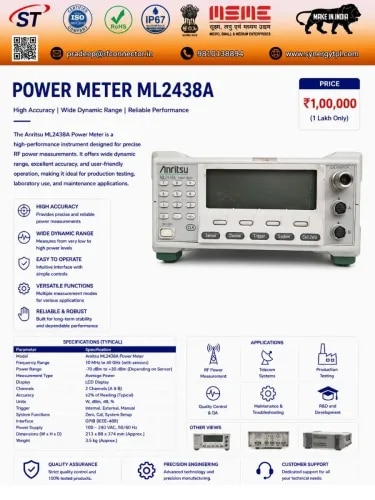 ANRITSU Anritsu ML2438A Power Meter is a high-performance dual-channel RF and microwave power measurement instrument d
ANRITSU ML 2438A POWER ...
INR 100000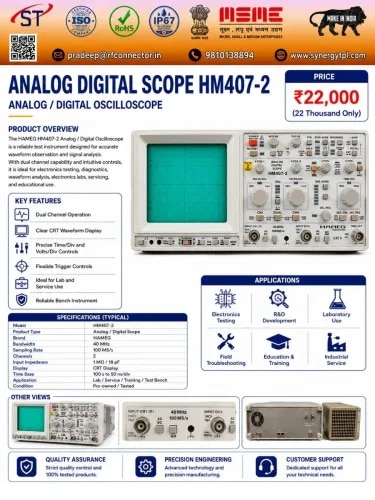 HAMEG HAMEG HM407-2 is a 40 MHz, two-channel analog/digital storage oscilloscope designed for laboratory, service, e
HAMEG HM407 -2 ANALOG /...
INR 22000